Flow quantification in a CDC bioreactor


Bioreactors are often used to observe what factors influence biofilm growth and removal. Biofilms are formed by pathogenic bacteria adhering to surfaces of food or materials, which can lead to infection on a large scale — with 48 million people getting sick from food-borne diseases linked to biofilm growth. The biofilm attachment process is heavily dependent on surface roughness of the object. A CDC Bioreactor is used in experimentation, with eight rods holding three coupons each, meaning there are 24 sampling opportunities varying material and surface roughnesses. Shear stress can be measured on each coupon, giving a better quantifiable understanding of how surface roughness influences the biofilm attachment process.
Flow through aortic valves: in vitro flow loop testing
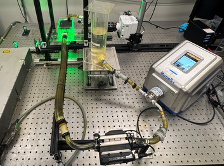

Cardiovascular disease (CVD) is one of the most prevalent and fatal conditions worldwide. To simulate cardiovascular dynamics, a lumped parameter modeling approach, based on the Windkessel model, was used to develop a mock circulatory loop (MCL) — comprising compliance chambers, resistances, a tank, a model, and a pulsatile syringe pump. Traditional MCL designs typically operate within a closed system delivering steady or pulsatile flow. This study introduces a soft robotic sleeve actuated by a pulsatile pump to more accurately replicate cardiovascular dynamics. The fluid subsystem uses a glycerol, water, and urea mixture to closely match the refractive index and blood-mimicking properties of the model, with particle image velocimetry used to quantify velocity distributions.
Low-speed aerodynamics with surface modification
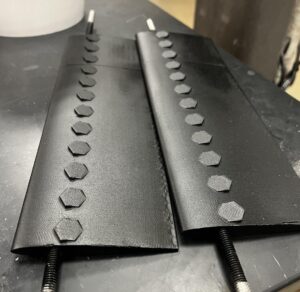
Interest in promoting laminar-to-turbulent flow transition to enhance lift over wings at low Reynolds numbers has grown significantly over time. Surface irregularities can amplify unstable waves in the fluid flow, causing earlier onset of turbulence and delaying separation. Our focus is on improving the aerodynamic performance of stationary or oscillating airfoils at low Reynolds numbers by introducing surface roughness, promoting a transition to turbulent flow that stabilizes the laminar separation bubble over the airfoil. The growing demand for Micro Aerial Vehicles (MAVs) in military and civilian applications makes surface flow control at low Reynolds numbers a critical area of research — we aim to uncover the fundamental physics of laminar-to-turbulent transition facilitated by hexagonal roughness elements.